CDMO, CMO, CRO: the short version
Three acronyms, three jobs. A CRO (Contract Research Organization) handles research: strain selection, screening, proof of concept. It doesn’t manufacture. A CMO (Contract Manufacturing Organization) manufactures to specs provided by the client: the process is locked, the CMO executes. A CDMO (Contract Development and Manufacturing Organization) does both: it co-develops the process AND manufactures at industrial scale. That dual capability is what sets it apart.
For a full breakdown of the differences between these three models, see the dedicated article: CDMO, CMO, CRO: What are the differences?
Signs it’s time to bring in a CDMO
On the technical side
The most common trigger: a process that works in the lab, but you don’t have the equipment to scale it. Going from 1–5 L to 2,000 or 50,000 L requires industrial fermenters, DSP units, drying capacity, and the expertise to manage scale transfer. Oxygen transfer, mixing homogeneity, batch-to-batch reproducibility: none of this gets solved by making the flask bigger.
Another signal: a DSP that isn’t industrializable yet. Lab-scale purification may not transfer as-is. Too many sequential steps, yields dropping at each unit operation, water and energy consumption spiraling. A CDMO with integrated DSP expertise can redesign the purification chain before it’s too late, meaning before production costs make the business model untenable.
Third situation: you need prototypes that are representative of the final product. Validating stability, testing in real application conditions at a customer’s site, preparing a regulatory dossier (Novel Food, additives, enzymes): all of this requires batches produced under near-industrial conditions, not lab samples. That’s the role of a pilot platform backed by an industrial facility.
Fourth signal: a change in microorganism or product format. Switching from yeast to filamentous fungi, from a liquid to a freeze-dried powder, from aerobic to anaerobic: these shifts radically change process constraints. A CDMO with diverse equipment and microbiology expertise absorbs these transitions without starting from scratch.
Last one, and often overlooked: drying. If the final format is a powder, the cryoprotection strategy, freeze-drying cycle, or spray-drying parameters need to be locked in early. They directly influence upstream steps (media composition, post-fermentation concentration, intermediate storage). A CDMO that integrates drying into its chain eliminates the back-and-forth between service providers.
On the business side
Don’t have the CAPEX to build your own production facility? For a biotech startup or a foodtech SME, investing in a full fermentation line (fermenters, DSP, drying, utilities, quality) means several million dollars and years of construction. A CDMO lets you produce without that investment, converting CAPEX into OPEX.
Need to move fast? Booking a slot at an equipped CDMO takes weeks. Building a production unit takes years. In sectors where time-to-market determines survival (precision fermentation, novel ingredients, alternative proteins), that difference in tempo is anything but trivial.
Want to test the market before committing? Initial commercial batches through a CDMO let you validate demand with real customers, without locking into an industrial asset. If the market responds, you can always internalize later. If the product pivots, losses are contained.
Your customer or investor demands compliance guarantees? A certified CDMO (ISO 9001, FSSC 22000, halal, kosher) provides a documented, auditable quality framework you may not have in-house, especially at the startup stage.
And a business signal that rarely gets said out loud: your R&D team is stretched thin. Outsourcing process development to a CDMO frees your internal resources for what you do best (the strain, the formulation, the IP) instead of scattering them across scale-up engineering.

What a CDMO actually delivers: the Fermentis case
Fermentis, a Lesaffre business unit specializing in fermentation solutions for beverages, had identified a lactic acid bacteria strain of interest for Kettle Sour beer recipes: SafSour LP 652™. A homofermentative strain capable of producing tropical, citrus, and fruity notes. The strain was selected. What remained was developing the process, managing scale-up, and ensuring industrial manufacturing of a reliable, stable freeze-dried lactic acid bacteria.
Fermentis turned to Ennolys. The industrialization team started at 20 L: fermentation media development fine-tuned to maximize cell count at end of culture, harvest optimization, cryoprotection formulation, freeze-drying cycle. All on a pilot installation that mirrors the characteristics of the industrial unit, producing prototypes strictly representative of the future commercial product.
Stability studies under real-time and accelerated conditions (climatic chambers) enabled shelf-life prediction from just six months of data. Throughout development, Fermentis tested prototype batches to validate strain quality and performance in actual brewing applications.
Result: scale-up on a 15 m³ fermenter delivered a compliant first commercial batch on the very first attempt.
Concentration, stability, acidification performance, and aromatic profile all aligned between pilot prototype and industrial product. Less than one year from project kickoff to a product ready for worldwide commercialization.
How to choose a CDMO
Not all CDMOs are created equal. The right choice depends on technical fit as much as the ability to collaborate.
First criterion: equipment compatibility. Fermenter sizes, aerobic or anaerobic capability, DSP capacity (filtration, extraction, centrifugation, membrane separation), drying options (freeze-drying, spray-drying). A CDMO that covers the USP + DSP + drying chain avoids transfer gaps between service providers.
Second: microbiological diversity. Bacteria, yeasts, filamentous fungi, microalgae. Technical versatility says something about methodological robustness and the ability to handle varied projects.
Third: a documented project pathway. Milestones, go/no-go criteria, fixed-price quotes for R&D, estimates for industrial production. Without that framework, costs drift and timelines stretch.
Fourth: intellectual property protection. NDA and MTA from the first exchange of confidential data, clear clauses on background and foreground IP.
And the most reliable criterion of all: concrete references. A successful transfer from pilot to commercial batch is worth more than a brochure.
How Ennolys supports Biotech projects
Ennolys is a Lesaffre business unit specializing in industrial fermentation for over 30 years, based in Soustons in southwest France. Its CDMO/CMO division supports industrial companies in transforming their microbial processes into robust, compliant production.
A seven-step project pathway
To ensure smooth and secure scale-up, Ennolys has structured a transparent project pathway designed to guide clients through every milestone:
- Initial contact to clarify needs and objectives, with no exchange of confidential data.
- Non-Disclosure Agreement (NDA) signed to protect all exchanges. The client shares a detailed protocol or completes the Ennolys technical questionnaire. Duration: ~2 weeks.
- Feasibility study with thorough analysis of technical information and a dedicated meeting to confirm process transposition to the facility. Duration: ~2 weeks.
- Quotation and planning with a fixed price for R&D and an estimate for the industrial phase. Costs and timelines are locked in from the start. Duration: ~4 weeks.
- Pilot scale (20 L) replicating the process and testing both fermentation and DSP. Depending on process maturity, 2 to 6 trials may be needed before a GO or NO GO decision. Duration: 4 to 6 weeks to secure the first R&D slot, then variable based on trials.
- Scale-up with adjusted industrial cost estimate, equipment reservation, documentation prep, and raw material sourcing. Three validation batches are required. Duration: ~3 months after R&D.
- Production with a supply contract established and manufacturing launched per the client’s forecast. Responsibility officially transfers from R&D to production teams.

Capabilities and certifications
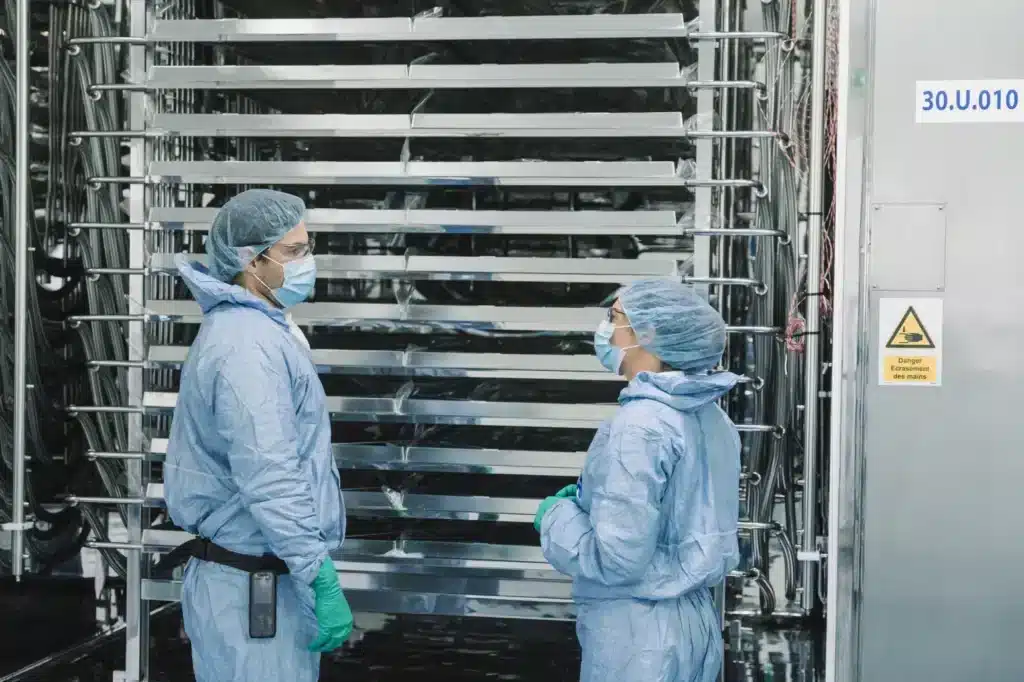
The site houses over 200,000 liters of fermentation capacity (fermenters from 100 L to 50,000 L), DSP unit operations (filtration, concentration, extraction, crystallization, centrifugal and membrane separation), two freeze-dryers with 30 m² of shelf area, and access to spray-drying through the Lesaffre network. Expertise covers bacteria, yeasts, filamentous fungi, and microalgae, serving markets from food to nutraceuticals, cosmetics, agriculture, and health.
Certifications: FSSC 22000, ISO 9001, halal, kosher. Teams on-site 24/7, full traceability through batch record documentation. In 2025, Ennolys achieved an EcoVadis score of 71/100 (Silver medal, top 10% of 150,000 companies assessed), with measurable environmental targets: 20% reduction in water withdrawal between 2022 and 2030, and 30% reduction in gross CO₂ emissions (Scopes 1 and 2) between 2019 and 2030.
Whether you’re a biotech startup with a promising strain or an industrial group looking for a scale-up partner, Ennolys offers a structured, technically rigorous framework for going from lab to production.