When the Bioreactor learns to run itself
Industrial fermentation looks manageable from a distance: inoculate, monitor, harvest. The reality is far messier. In large-scale fermenters, nutrient distribution, temperature, dissolved oxygen, and cellular behavior fluctuate constantly. What engineers call the “scale-up effect” — the performance gap between pilot and industrial scale — costs months of process development and significant overruns at every transition.
Artificial intelligence, and machine learning (ML) in particular, tackles this problem by reading real-time sensor data streams, modeling nonlinear interactions between variables, and adjusting process parameters before a deviation becomes a failure. A 2026 review in Biotechnology Advances describes a framework where AI no longer simply assists the operator — it turns the bioreactor into “a cognitive entity capable of perception, learning, and self-optimization.”[1]
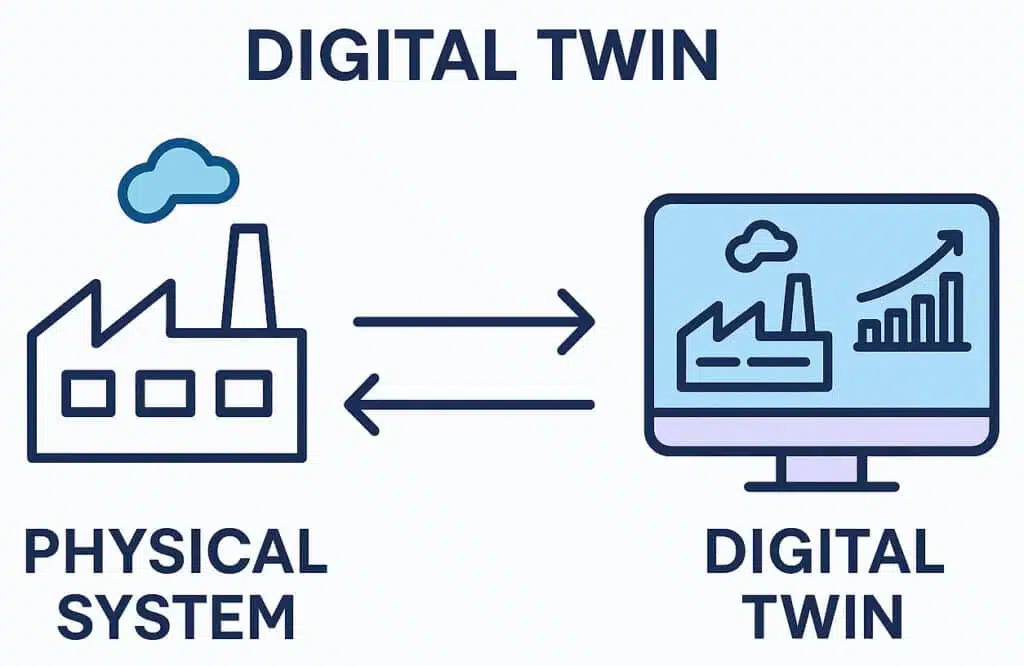
That’s not science fiction. It’s the technical definition of a digital twin — a computational replica of the bioprocess running in parallel, ingesting real-time data, and proposing or executing closed-loop corrections. Early implementations are already operational in advanced research settings, and events like Advanced Fermentation Technology 2026 (Adebiotech / Université de Lille, June 30 – July 1, 2026) are dedicating entire sessions to the topic.[2]
Measurable results, not vague promises
The most concrete example comes from the production of an enzyme (α-amylase) by a common microorganism, Aspergillus niger. Researchers deployed twelve distinct AI methods, paired with a real-time fermentation sensor and a fine-grained analysis of gene activity. Their system pinpointed, through a specialized algorithm (Random Forest), that glucose concentration was the most critical factor to control, a finding that conventional approaches would have struggled to uncover with such precision.
By automatically adjusting this parameter in real time, they maintained sugar levels at their optimal range throughout fermentation. The gains are quantifiable: +46% increase in enzyme production, 28 fewer process hours, and a record-breaking concentration level[3]. These figures come from a peer-reviewed scientific publication.
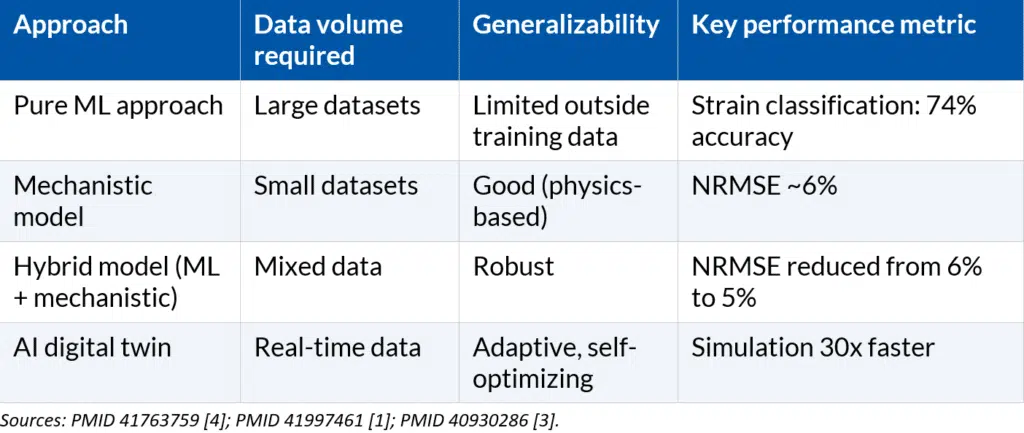
For food fermentation, a recent study introduces a crucial nuance, often overlooked: while pure AI models excel when fed large, diverse datasets, their reliability drops outside the exact conditions they were “trained” on.
The most robust solution? A hybrid model, one that combines a solid theoretical foundation (grounded in the physical and chemical laws of the process) with an AI module that fine-tunes this framework using real-world data. This synergy improves predictive accuracy and cuts computation time by a factor of 30[4].
The takeaway for industry professionals is clear: AI doesn’t replace domain expertise, it enhances it. The theoretical model remains the reliable bedrock; AI refines and corrects it by leveraging on-the-ground data.
Table — Modeling Approaches in Fermentation: A Comparative Overview
3 practical levers for flavor and enzyme fermentation
- Strain prediction and selection. Classification algorithms can distinguish yeast strains by their metabolic profiles, achieving 74% accuracy on experimental data.[4] In natural flavor applications — where strain selection determines the final aromatic profile — these tools reduce the number of screening experiments needed.
- Online monitoring and advanced sensors. Raman spectroscopy, biosensors, and soft sensors continuously feed ML models. A 2025 review in Bioresource Technology (PMID 40170318) synthesizes the state of the art: sensor-AI coupling enables dynamic control where traditional lab analysis introduces time lags that compromise batch quality.
- Data standardization for robust model training. A recent research project introduces an open-source classification system designed specifically for precision fermentation[5]. Its goal? To make fermentation data directly usable by AI by enforcing a common, structured format. This standardization is essential for training predictive models that are generalizable enough to apply across different processes, rather than being confined to a single use case.
What’s still holding things back (and it’s not the algorithm)
The main obstacle isn’t algorithmic power. It’s data quality and volume. No matter how sophisticated, ML models are only as good as their training data. A poorly documented process, miscalibrated sensors, or a heterogeneous dataset will produce unreliable — potentially dangerous — predictions if those predictions drive automated decisions.
The second barrier is interpretability. A black-box algorithm can flag glucose as “the critical variable” without explaining why. In regulated contexts — food ingredient or pharmaceutical production — the traceability of automated decisions is a non-negotiable requirement.
The third barrier is cross-scale transfer. A recent scientific synthesis puts it bluntly: “Microbial strains optimized in the lab often see their performance plummet under the harsher conditions of industrial-scale bioreactors.”[6] AI can help predict these discrepancies, particularly through models that simulate both the physical environment of the bioreactor and the cells’ response. But for this approach to be effective, it must be fed with data from real industrial-scale operations, not just lab-scale pilot studies.
The institutional picture: money and momentum
Interest in AI for industrial fermentation has moved well beyond academia. In March 2026, the U.S. Department of Energy announced $293 million for the Genesis Mission, an initiative to accelerate AI in the biological sciences, explicitly including biotechnology and biomanufacturing.[7] The stated goals: compress R&D cycles, develop AI-powered digital twins for scale-up, and build shared “AI-ready” biological databases.
In France, the Ferments du Futur program (INRAE / ANIA, €48.3M funded through France 2030) explicitly integrates AI and data science for microbial consortia design and process optimization.[8] It is currently the largest national platform of its kind in Europe.
On the market side, analyst projections should be read as order-of-magnitude estimates rather than firm figures: Precedence Research values the global precision fermentation market at $4.91 billion in 2025, with a projection of $75.76 billion by 2035.[9] The direction of travel is clear; the exact trajectory less so.
What this means for Ennolys — and its clients
Ennolys operates precisely at the intersection of these developments. As a producer of natural aroma molecules through fermentation (vanillin, lactones, acetaldehyde, organic acids) and a CDMO through its fermentation and DSP services, Ennolys works on the same variables AI is learning to optimize: strain, substrate, temperature, kinetics, yield, and aromatic profile.
AI Models in Process Development is a growing competitive edge, but full deployment demands the right infrastructure. While predictive tools are becoming more accessible, their effectiveness hinges first and foremost on the quality and volume of data collected. Today, the value Ennolys brings to the table still stems from our domain expertise and scale-up know-how—but we recognize that data is the key to ensuring process reproducibility and optimization. That’s why, in partnership with Optimistik, we’ve launched a digital transformation initiative to progressively structure and leverage our operational data. This evolution, pursued with pragmatism, aims to strengthen our core capabilities before moving toward deeper integration of predictive modeling.
The question isn’t whether AI will transform industrial fermentation. It already is, in advanced research labs and in some production facilities. The algorithms exist. The monitoring tools are accessible. The public funding is in place. What will determine the competitive gap over the next three years is the capacity to instrument existing processes and get data into shape, before handing it to a model.
Are you working on an industrial fermentation project?
Are you integrating AI into your bioprocesses or exploring precision fermentation?
Ennolys and its CDMO division support your industrial fermentation projects—from development to industrial-scale production, including scale-up. Contact our teams to discuss your project.

FAQ — AI and Industrial Fermentation
1. Can AI replace the microbiologist?
No — and the data backs that up. Pure ML models fail when data is scarce or out of distribution. Scientific expertise remains essential to define the right variables, interpret anomalies, and validate automated decisions. AI enhances the microbiologist’s capabilities; it does not replace them.
2. What is a digital twin in a fermentation context?
A digital twin is a computational model that replicates the behavior of a real bioprocess in real time. It ingests sensor data, predicts deviations, proposes corrections, and can automatically control certain parameters (temperature, feed rate, pH). In fermentation, it addresses the scale-up problem by simulating large-scale behavior before physically running the experiment.
3. Which fermentation types benefit most from AI today?
The best-documented processes — enzyme fermentation, secondary metabolite production, brewing, winemaking — offer the densest datasets and therefore the most demonstrable AI gains. In natural flavors, strain selection and culture condition optimization are the two most immediate entry points.
4. Is AI in fermentation accessible to smaller companies?
The core tools (Random Forest, lightweight neural networks, soft sensors) are open-source and can be integrated into existing workflows. What remains costly is fermenter instrumentation (inline sensors, Raman spectroscopy) and data quality management. Partnering with an equipped CDMO is often the fastest path to these capabilities without internal capital investment.
5. What’s the difference between precision fermentation and AI-optimized fermentation?
Precision fermentation refers to the use of genetically engineered microorganisms to produce specific molecules (proteins, enzymes, flavors). AI is one of the tools accelerating it — but it applies equally to conventional, unmodified fermentation processes. AI is a cross-cutting technology; precision fermentation is a process category.
Sources
[1] Gu Q, Yu J, Liu Y, et al.. Harnessing bioreactor heterogeneity: From gradient understanding to autonomous control via multiscale modeling and intelligent optimization. Biotechnology Advances. 2026. PMID: 41997461. DOI: 10.1016/j.biotechadv.2026.108899
[2] Adebiotech / Université de Lille.. Advanced Fermentation Technology 2026 (AFT) — Official Program. asso.adebiotech.org. 2026.
[3] Wang Y, Wang Y, Xu F, et al.. Artificial intelligence-driven fermentation optimization for α-amylase hyperproduction enabled by Raman monitoring and metabolic network analysis. Bioresource Technology. 2025. PMID: 40930286. DOI: 10.1016/j.biortech.2025.133287
[4] Campo-Manzanares N, Moimenta AR, Balsa-Canto E.. Critical assessment of machine learning approaches for classification, dynamic prediction and surrogate modeling in food fermentation. Food Research International. 2026. PMID: 41763759. DOI: 10.1016/j.foodres.2026.118403
[5] Collective authors (preprint).. PREFER: An Ontology for the PREcision FERmentation Community. arXiv. 2026. DOI: arXiv:2602.16755
[6] Yuan S, Xu V, Muddana C, et al.. From design-build-test-learn cycles to AI-driven digital twins for bioprocess scale-up in the Genesis Mission era. Current Opinion in Biotechnology. 2026. PMID: 42190350. DOI: 10.1016/j.copbio.2026.103516
[7] U.S. Department of Energy.. DOE announces $293 million for the Genesis Mission to support AI research and development in biosciences. globaltradealert.org / thelconsulting.com. 2026.
[8] INRAE / ANIA.. Programme Ferments du Futur — France 2030. hal.inrae.fr. 2023. DOI: hal-04176537
[9] Precedence Research.. Precision Fermentation Market Size, Share, Trends & Forecast 2025–2035. precedenceresearch.com. 2026.