Fermentation Scale-Up: more than a science problem
Science, strategy, execution and timing
At small scale, the goal is optimization: yield, productivity, product profile. The lab is a controlled environment where variables stay manageable. At industrial scale, the question shifts completely: can this bioprocess run reliably, at pace, with the level of control and traceability the target market demands?
That’s a fundamental difference. Scaling is not just a volume increase. It’s a system transformation — covering process, operations, quality, documentation, and partners.
Timing matters just as much as science. Scale-up doesn’t come “after” strategy; it is part of the strategy. The industrial model (make, toll manufacturing, or CDMO), fermentation configuration, DSP architecture, quality specifications, and regulatory roadmap all need to be locked in simultaneously. Many projects don’t fail on the science. They fail because industrialization and commercialization were sequenced wrong.
Where lab-to-plant transitions break down
Moving to industrial scale changes the rules. The most common failure points:
Oxygen transfer and mass transfer
In aerobic fermentation, oxygen transfer capacity becomes the first bottleneck. What works at small scale stops working when cell density rises and hydrodynamics change. Aeration, agitation, and nutrient availability all drive strain metabolic behavior in ways that are easy to underestimate during scale-up.
- Mixing, gradients, and control
Temperature, pH, foam: all of these become much harder to homogenize in vessels measuring dozens of cubic meters. Gradients generate variability. Variability generates quality drift.
- Batch-to-batch reproducibility
At industrial scale, the target isn’t “it works.” It’s “it works on every campaign, within spec.”
- Operational constraints
CIP/SIP, hygienic design, utilities, cycle times, product changeovers, contamination prevention — none of these exist in the lab, but all of them structure production.
- Underestimated DSP
This is the most consistent blind spot. Downstream processing can account for a substantial share of production costs and yield losses, especially when high purity is required or when the purification train becomes too long. DSP must be designed as a core pillar of the process — not bolted on after fermentation.
Classic mistakes to avoid ?
- Scaling before the product is locked. Chasing performance targets on a moving spec — product form, application, market — is the fastest way to burn time and budget.
- Deferring DSP. The surest path to discovering too late that your purification strategy doesn’t scale, that water and energy consumption is unsustainable, that yield collapses, or that the chosen DSP is too complex to implement at a CDMO/CMO partner.
- Underestimating raw materials. Availability, inter-batch variability, certification constraints (organic, non-GMO, halal, kosher), effluent impact and critically, direct impact on the robustness of your microbial process.
- Choosing an industrial partner on price alone. Equipment compatibility, fermenters, DSP units, drying options, must be validated before locking the process. A technical mismatch found after technology transfer is expensive.
- Treating regulation as a final formality. In Europe, the regulatory pathway shapes product identity, specifications, and therefore the process itself. Integrating it at the end means risking a full process rework.
What are the key stages in fermentation scale-up?
Stage 1: Validate the market and lock product specifications
Scale-up starts on the market side. If the customer benefit hasn’t been validated and quantified, industrialization risks becoming a blind investment. An innovation can be scientifically solid and still fail if it doesn’t address a real, fundable need with a viable business model.
Then come product specifications: critical criteria (activity, purity, impurities, sensory profile if applicable, microbiology), stability, format (liquid or powder), application constraints. This is what enables quality by design. The principle that guides media development, strain selection, fermentation strategy, and DSP.
Quality is engineered in from the start. It cannot be tested in afterward.
From a project management standpoint, locking specifications sets the framework: clear objectives, go/no-go criteria, and fewer costly iterations downstream.
Stage 2: Choose the right fermentation and DSP configuration
This is where the industrial architecture gets assembled. A few principles worth internalizing:
Fermentation mode. Batch and fed-batch remain industrial standards for good reasons: simplicity, control, and scalability. In fed-batch, feeding strategies, foam management, run duration, and contamination risk all need to be mastered at pilot scale before anything else.
DSP: think “industrial” from the start. The objective isn’t to transfer the best lab technology; it’s to build the most robust, transferable, economically defensible chain. Too many sequential steps means cumulative losses, high CAPEX, indefensible COGS, and a harder technology transfer to a CDMO.
Don’t forget drying. If the final format is a powder, the cryoprotection, lyophilization, or spray-drying strategy needs to be defined early. It affects upstream steps: media composition, post-fermentation concentration, intermediate storage conditions.
The most effective approach is an integrated view covering fermentation (USP), purification (DSP), and drying — link by link. This is exactly the logic behind Ennolys: an integrated value-chain offering that avoids the most common scale-up error — treating upstream in isolation from downstream.
Stage 3: Navigate european regulatory frameworks
In Europe, regulation is not a layer added at the end. It’s a design constraint.
Depending on the target category (food, nutraceutical, cosmetic, agriculture), classification, safety, traceability, and labeling require specific data. Food products may fall under distinct frameworks — Novel Food, additives, enzymes, GMOs — with substantive scientific evaluations and strong expectations on product identity, specifications, and process consistency.
The practical implication: the earlier regulatory strategy is integrated, the smoother industrialization will be. Fewer late-stage process and spec revisions, fewer surprises at dossier submission.
Stage 4: When and how to leverage CDMOs
At this stage, the business question becomes: how do you accelerate toward industrial scale without burning capital (CAPEX) or losing control (IP, quality, schedule)?
The decision sits between three models: make (in-house production), contract manufacturing/toll manufacturing (outsourced production based on a supplied process), and CDMO (development plus manufacturing externalized). Each implies a different tradeoff between control, cost, flexibility, and risk.
How to get the most from a CDMO partnership:
- Arrive with a clear process book (even a simplified one) and realistic specifications.
- Validate technical fit: fermenter design, DSP capabilities, drying options, compliance requirements.
- Structure project governance: milestones, success criteria, risk management.
- Protect IP: NDA/MTA, background/foreground clauses, rules for sharing and exploitation.
A good CDMO partner is more than a service provider. It’s an accelerator. But that relationship works best when the client comes prepared.

How Ennolys supports fermentation scale-up?
Ennolys is a business unit of Lesaffre with over 30 years in industrial fermentation, based in Soustons in southwest France. The company operates across a site of nearly 5 hectares with 100 staff and runs two distinct activities: proprietary products (natural flavor molecules and solutions, including vanillin and acetaldehyde) and custom fermentation services through its CDMO/CMO division.
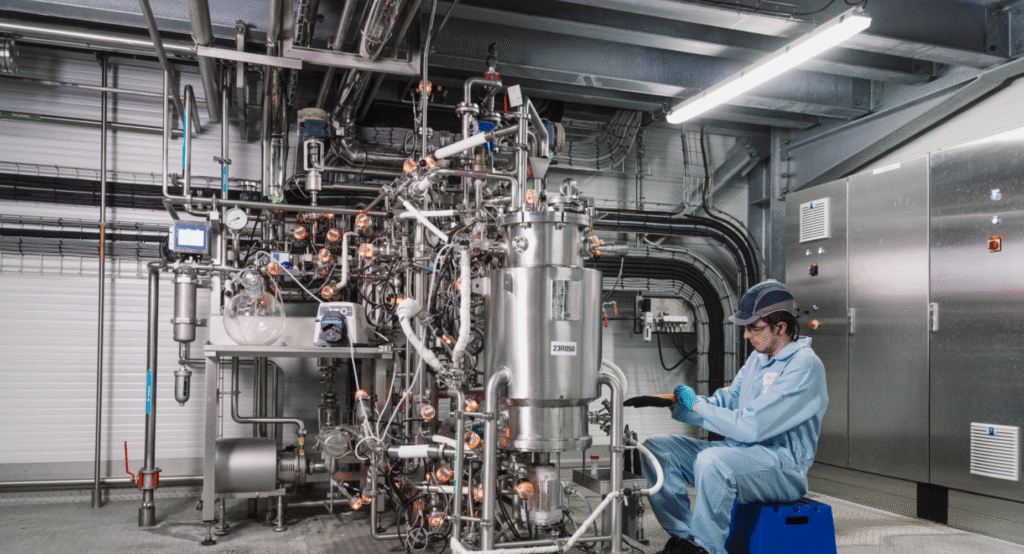
Ennolys handles the industrialization of microbial processes from scale-up through full industrial production. With over 200,000 liters of fermentation capacity across vessels from 100 liters to 50,000 liters, the platform offers broad flexibility in volume and process type. Expertise covers a wide range of microorganisms: bacteria, yeasts, filamentous fungi, and microalgae.
The offering is structured as an integrated value chain:
- Fermentation (USP): batch and fed-batch runs, aerobic or anaerobic.
- Purification (DSP): filtration, concentration, extraction, crystallization, centrifugal and membrane separation.
- Drying: on-site lyophilization (two industrial freeze-dryers) and spray-drying via a partnership with Lesaffre Ingredients Service.
- Quality: FSSC 22000 and ISO 9001 certified, halal and kosher certified, full traceability (batch record per production run), 24/7 on-site teams.
Operating across food, nutraceutical, cosmetic, flavor, and agricultural sectors imposes rigorous discipline on specifications, compliance, and process robustness. For biotech and foodtech companies preparing a scale-up, Ennolys provides the infrastructure, the multidisciplinary expertise (chemists, microbiologists, biotechnologists, flavorists), and the industrial culture needed to take a pilot process to commercial production.
Fermentation scale-up is not an isolated technical step. It’s a structural strategic decision. Getting it right means aligning market validation, specifications, process parameters, DSP strategy, regulatory compliance, and industrial model — early, and together. The goal is clear: reduce uncertainty, avoid dead ends, and turn a lab innovation into a controlled industrial process without losing time or grip along the way.
To explore deeper the topic of scale-up, we invite you to download our free white paper ‘How to accelerate your biotech project, from idea to market.’